
Remote collaboration fuses more citable ideas (Now)
Published:
Click here for the full project website, including code and data.
Remote Collaboration and Scientific Impact
As science becomes more connected, remote collaboration is increasingly common. But does working across distance weaken scientific creativity? A 2023 Nature paper by Lin et al. suggested that it might: across more than 20 million research papers published between 1960 and 2020, teams working at greater distances appeared less likely to produce disruptive, breakthrough research.
The study used the “D score,” a measure of disruption based on later citations. A paper receives a high D score when later work cites it without also citing its predecessors—suggesting that the focal paper has displaced earlier ideas. Lin et al. reported a negative relationship between collaboration distance and D score: remote teams, on average, produced fewer disruptive papers than teams working in the same location.
The paper attracted substantial attention, but it also prompted methodological concerns. Hawley (2023), for example, questioned the quality and distribution of the data, the explanation of the statistical models, and possible confounding factors. This project focuses on one particularly important issue: missing D scores.
Why are D scores missing?
Around 28% of papers in the dataset have no D score. This is not random missingness. A D score cannot be calculated when a paper has never been cited, because the measure depends on later papers citing the focal work. If no one cites the paper, its denominator is zero and the score is undefined.
It may be tempting to assign uncited papers a D score of zero. However, this would be difficult to justify. A paper with a low or negative D score has still been cited and has participated in an existing citation network. An uncited paper has had no measurable influence in that network at all. Treating these two situations as equivalent could distort the analysis.
Therefore, rather than ignoring papers with missing D scores, this project examines whether the probability of being cited is related to collaboration distance.
Does distance affect the likelihood of being cited?
Papers were grouped by the maximum distance between collaborators:
0 km
0.1–1,000 km
1,000–5,000 km
5,000–10,000 km
10,000–15,000 km
15,000–20,000 km
For each year and distance group, I calculated the proportion of papers that received at least one citation. I then compared each remote group with the 0 km group using odds ratios. An odds ratio above 1 means that papers produced through remote collaboration were more likely to be cited than papers produced entirely on site.
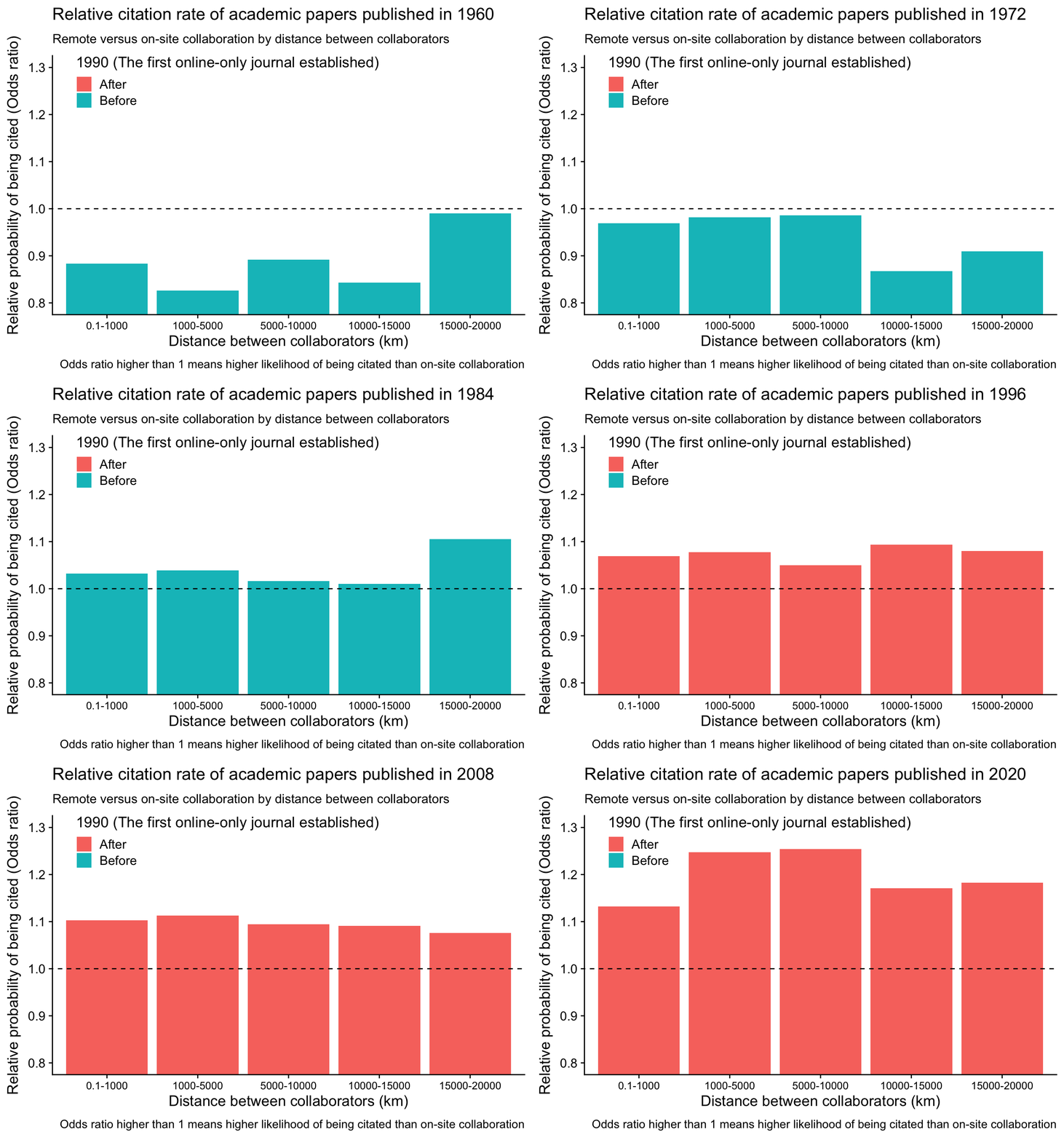
The results show two broad patterns.
First, from roughly 1990 onward, remote collaborations were generally more likely to produce cited papers than on-site collaborations. This pattern becomes more stable after 2010. One plausible explanation is that communication technologies have reduced the practical cost of collaborating across distance. The growth of the scientific literature may also make estimates more stable in recent years because the number of observations is much larger.
Second, estimates vary more widely at longer distances. This is likely because relatively few teams collaborate across very large geographic distances. Smaller groups produce less precise estimates, so apparent changes at the longest distances should be interpreted cautiously.
Why do uncited papers matter?
Ignoring uncited papers changes the question being answered. If we study only papers with valid D scores, we are studying only papers that have already entered the citation record. That may be useful, but it cannot automatically support a conclusion about the overall effect of remote collaboration on scientific output.
This distinction matters because a large share of papers—about 28% in this dataset—are uncited. If collaboration distance affects whether a paper is cited at all, then excluding uncited papers may introduce selection bias. The relationship between distance and disruption among cited papers may not represent the relationship between distance and scientific impact across all papers.
The original study noted that citation counts tend to rise with collaboration distance, arguing that disruption is distinct from citation. That argument may be reasonable among papers that have already been cited. However, it does not resolve the issue of papers with no citations, for which disruption cannot be measured.
Should researchers avoid remote collaboration?
Probably not. The evidence does not support a simple conclusion that remote collaboration is harmful to science. Lin et al. found that on-site teams had a modest advantage on their measure of disruption. In contrast, this analysis suggests that remote teams have been at least as likely—and in recent decades, often more likely—to produce papers that receive citations.
These findings should not be treated as proof that remote collaboration causes better outcomes. Collaboration distance is linked to many other factors, including discipline, resources, reputation, team composition, institutional prestige, and the kinds of projects researchers choose to pursue. Large datasets can also make very small differences appear statistically significant, so effect sizes deserve more attention than significance tests alone.
The practical lesson is simple: researchers should choose collaboration arrangements based on the needs of the project and the people involved. Remote work may make some kinds of conceptual coordination harder, but it can also connect complementary expertise, resources, and perspectives that would otherwise remain separate.
Conclusion
Re-examining the missing D scores reveals an important limitation in the original analysis. Uncited papers are not merely incomplete observations; they represent a substantial part of scientific output, and their exclusion may be related to collaboration distance.
Using the same dataset, this project finds that remote collaboration is associated with a higher likelihood of citation in recent decades. This does not overturn the original paper conclusively, but it shows that the relationship between distance and scientific impact is more complicated than a single disruption score suggests. Transparent methods, complete reporting, and careful treatment of missing data are essential before drawing broad conclusions about how scientists should collaborate.